24 November 2026 — Ramzi Chamat
Geneva Zone 5 Villa Market: Densification and Key Challenges
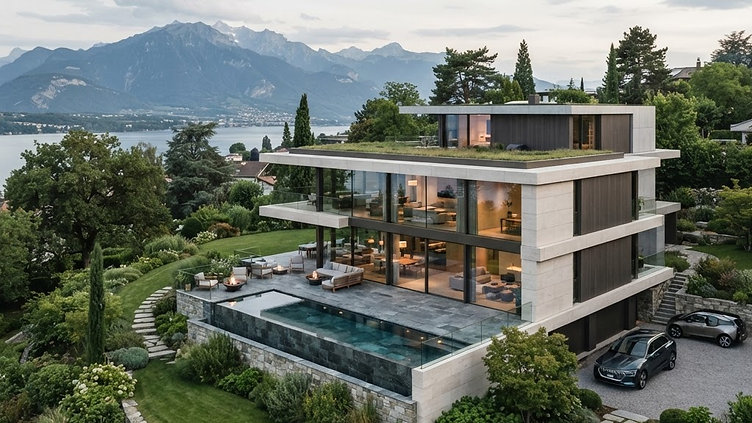

The market for villas in Geneva's Zone 5 is undergoing a profound transformation. With a cantonal vacancy rate of 0.31% as of June 1, 2026 [OCSTAT], the villa zone, which covers a significant portion of buildable land intended for housing, has become the primary lever for internal densification. For OAKS GROUP SA, this transformation is not merely about adding surface area, but about the precise management of land potential.
The densification of Zone 5: a demanding regulatory framework
Spontaneous densification has given way to a planned approach. Since the update to the Law on Constructions and Various Installations (LCI) on October 1, 2020, qualitative requirements have been strengthened. Article 59 LCI sets the base density at 25% of the plot surface, with potential increases to 27.5% for the High Energy Performance (HPE) standard and 30% for the Very High Energy Performance (THPE) standard.
Obtaining higher exemptions (up to 44% or 48% for THPE) is now conditional on the plot being located within an "increased densification sector" identified in second-generation communal master plans (PDCom), approved by the Council of State. This planning has become the major determinant of a property's development value.
Sales and divisions: the market for plots
The villa market remains characterized by structural scarcity. The division of plots or the grouping of neighboring land are common strategies to optimize buildable potential. For an owner, value no longer depends solely on the land size, but on its capacity to accommodate densification that complies with new "full soil" requirements (art. 59-3bis LCI), which mandate preserving a significant portion of the ground without construction or paving.
Vertical extensions: an alternative to ground-level densification
Vertical extension (surélévation) is emerging as a solution to create new living space without increasing the building footprint. Each intervention remains subject to a strict evaluation of building envelopes and heritage integration. For a villa in Zone 5, a vertical extension must respect the current height regulations. The cost of such an operation requires a preliminary technical feasibility study to validate the existing structure and ensure compliance with energy standards necessary to maintain or increase the soil utilization rate.
Key Takeaways
- Zone 5 represents a major share of Geneva's buildable land, making it the priority land reserve.
- The base floor area ratio (IUS) is 25%, adjustable based on energy performance (HPE/THPE).
- Density exemptions are now limited to "increased densification sectors" defined in communal PDComs.
- Preserving "full soil" (pleine terre) is a mandatory regulatory constraint for any project.
- Vertical extension is a viable alternative, strictly governed by building envelope and integration rules.
Frequently Asked Questions
How do I know if my plot is in an increased densification sector?
You must consult your municipality's communal master plan (PDCom), available on your town hall's website or the cantonal mapping portal (SITG). Only sectors identified as "increased densification" generally allow for density exemptions under Art. 59 para. 4 LCI.
Is dividing my plot still possible?
The division depends on compliance with density rules, boundary setbacks, and the required minimum surface of "full soil." A feasibility study by a professional is essential to verify if the resulting plot can support construction that meets current standards.
What is the impact of energy performance on my building rights?
The HPE standard allows the IUS to increase from 25% to 27.5%, and the THPE standard to 30% in standard Zone 5. For increased densification sectors, these standards are often necessary conditions to reach the higher rates of 44% or 48%.
Sources
- State of Geneva, Densification de qualité de la zone 5
- rsGE L 5 05, Loi sur les constructions et les installations diverses (LCI)
- HILO Architectes, Bonus de densification : Genève et canton de Vaud
- Cour de justice, Arrêt A/2417/2024 du 24 mars 2026