13 November 2026 — Ramzi Chamat
Rooftop Extensions in Geneva: Potential and Economics
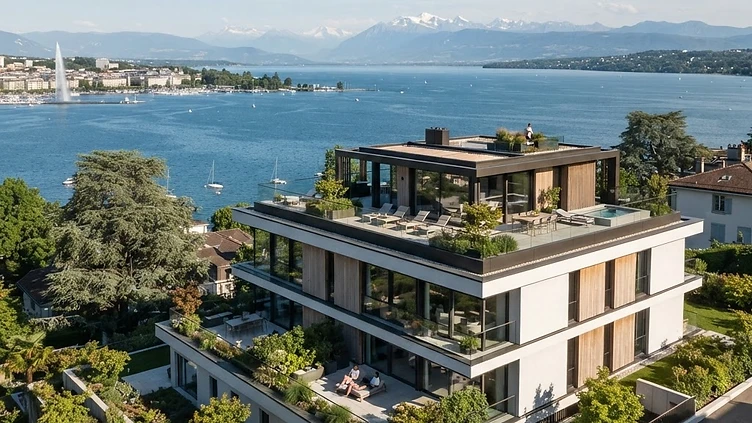

In Geneva, the scarcity of land and structural tension in the real estate market necessitate densifying the existing built environment rather than urban sprawl. Rooftop extensions have emerged as a concrete solution to create new living spaces without consuming additional land. At OAKS GROUP SA, we observe that while this process is complex, it serves as a major lever for asset appreciation when managed with rigor.
The Potential for Rooftop Extensions: A Case-by-Case Analysis
Identifying the potential for a rooftop extension does not guarantee a building permit. Each project must be evaluated against strict criteria: the authorized building envelope (gabarit), heritage constraints, and the structural capacity of the existing building. Zones 2 and 3 are particularly favorable for these interventions, in accordance with the provisions of the Law on Constructions and Various Installations (LCI) [10], but every plot requires an in-depth technical and urban planning feasibility study to validate actual constructibility.
Procedure and Key Feasibility Steps
Success in a rooftop extension project relies on a rigorous methodology, typically structured around several essential stages:
- Pre-analysis: Evaluation of constructible potential and regulatory constraints via the SITG [8].
- Technical studies: Verification by a civil engineer of the foundations' and structure's capacity to support additional floors [4, 9].
- Architectural sketch: Harmonious integration of the project into its urban environment [4].
- Financial assessment: Modeling of construction costs, fees, and exit pricing [2, 9].
- Building permit: Submission of the application to the Office of Building Authorizations (OAC) [8, 9].
The Economic Equation: Balancing Cost and Value
Adding floors allows for the creation of surface area without purchasing land, which is an undeniable economic advantage. However, construction costs are high, estimated between 2,800 and 5,500 CHF/m² in French-speaking Switzerland depending on the complexity of the site [3, 9]. The developer must also account for risks related to early technical studies and potential reductions in building envelopes imposed by authorities [8, 9]. The economic equation must reconcile densification, architectural quality, and financial viability to ensure the operation's profitability [8].
Energy Performance: An Imperative for Value
A rooftop extension is an ideal opportunity to improve the building's overall energy performance. New surfaces must meet current energy standards, which durably enhances the entire asset [8]. This qualitative densification helps finance the renovation of existing structures while meeting the housing needs of the Geneva population [4, 8].
Key Takeaways
- Rooftop extensions are a strategic response to Geneva's housing shortage, particularly in zones 2 and 3 [8, 10].
- Project success depends on a prior technical and urban feasibility study, with no guarantee of authorization [8].
- Construction costs range from 2,800 to 5,500 CHF/m², requiring a rigorous financial balance sheet [3, 9].
- Qualitative densification, incorporating high energy standards, is the primary lever for property value appreciation [8].
Frequently Asked Questions
Can any building in Geneva be extended upwards?
No. Rooftop extensions are mainly possible in zones 2 and 3, and each project is evaluated on a case-by-case basis by the competent authorities according to the building envelope, heritage protection, and the built environment [8].
What are the main financial risks of a rooftop extension?
The main risks include unforeseen costs related to the existing structure, delays in obtaining building permits, and potential project modifications imposed by authorities [8, 9]. An in-depth feasibility study is essential to limit these uncertainties before any commitment [8].
Does a rooftop extension help create affordable housing?
While rooftop extensions densify without urban sprawl, their affordability depends on the legislative mechanisms in force [8]. Without specific constraints, the created units are often positioned at the higher end of the market, although the operation can help finance the renovation of existing structures [8].
Sources
- Ville de Genève, Règlement relatif aux plans d'utilisation du sol, 1er décembre 2021
- HILO Architecture, Bonus de densification : Genève et canton de Vaud, 28 juillet 2026
- HILO Architecture, Surélévation d'immeuble en Suisse : coûts réels, 2 mars 2026
- Moser Vernet & Cie, Surélévation d'immeubles à Genève, 1er juin 2026
- État de Genève, Plan directeur cantonal Genève 2030, 20 janvier 2022