22 November 2026 — Ramzi Chamat
Geneva property market 2025: 3,327 sales, CHF 8.06 billion and a house price record
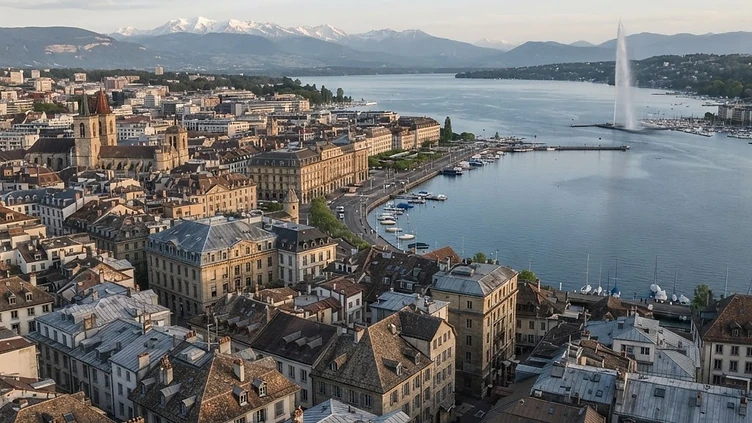

The cantonal statistics office (Ocstat) has published the results of the Geneva property market for 2025. The figures, reported by the Tribune de Genève on 20 November 2026, describe a market that has recovered activity without recovering its peak value: 3,327 transactions, 363 more than in 2024, for a total of CHF 8.055 billion, against CHF 7.819 billion a year earlier, yet still below the 2020-2022 levels.
For a developer, an owner or a buyer, the useful information is not the total but its composition. That is where the signals sit: the recovery comes from condominiums, houses are selling less, and the gap between the free market and the controlled development zones remains wide.
The figures published by Ocstat
Indicator (2025) | Value | Change |
|---|---|---|
Total value | CHF 8.055 bn | versus CHF 7.819 bn in 2024 |
Average ticket per transaction | CHF 2.42 m | CHF 2.64 m in 2024 (-8.2%) |
Condominiums sold | 1,697 (51% of sales) | versus 1,423 in 2024 |
Detached houses sold | 732 (22% of sales) | versus 790 in 2024 |
Multi-dwelling or commercial buildings | 6% of transactions | house sales volume stable at CHF 2.396 bn |
Bare land | 4% of transactions | — |
Other assets (garages, parking spaces) | 17% of transactions | — |
Median house price | CHF 2.213 m | +1.1%, a new record |
Median apartment price, free market | CHF 1.37 m, i.e. CHF 11,022/m2 | +25.1% since 2017 |
Median apartment price, development zone | CHF 769,000, i.e. CHF 6,866/m2 | — |
The recovery comes from condominiums
In 2025, 1,697 apartments changed hands, against 1,423 a year earlier: condominiums now account for 51% of all transactions. Detached houses fell to 732 sales, from 790 in 2024, a low level over the past ten years, while the total value of those sales stayed practically stable at CHF 2.396 billion.
The remaining 27% splits between multi-dwelling or commercial buildings (6%), bare land (4%) and other assets, notably garages and parking spaces (17%).
What the total hides: the average ticket is falling
A rising total does not say whether prices are climbing or the market is changing shape. The ratio between the two does: CHF 8.055 billion divided by 3,327 transactions gives an average ticket of CHF 2.42 million. In 2024, CHF 7.819 billion across 2,964 transactions gave CHF 2.64 million.
In other words: sales up 12.2%, value up 3.0%, and the average amount per transaction down 8.2%. The market is not overheating; it is shifting towards smaller and cheaper assets, namely condominiums, and within them the price-controlled apartments.
Two cautions: the average ticket is an arithmetic mean, sensitive to very large transactions (buildings, land), and it blends categories that have no common price. It does not replace a median, but it points to a direction that the house median alone conceals.
The house record, to be read with care
The median price of a detached house reached CHF 2.213 million, against CHF 2.19 million in 2024 (+1.1%), above the previous record of CHF 2.195 million set in 2022. Since 2017 the increase reaches 38.3%, although that comparison does not cover identical properties each year. In Cologny, the most expensive municipality for houses, the median reaches CHF 7.5 million.
Two cautions apply: the median rests on a small number of sales, and a thin market is sensitive to the mix of transactions. A record set on 732 sales does not carry the same weight as one set on a deep market.
One more signal points the same way: if the total value of house sales stays practically stable at CHF 2.396 billion while volumes fall 7.3%, the average price per house rises mechanically by around 8%, assuming a comparable 2024 figure. The median, by contrast, moves only 1.1%: the increase is concentrated at the top of the market, in Cologny and a handful of municipalities, rather than across all houses.
Two apartment markets that do not resemble each other
On the free market, the median apartment price reaches CHF 1.37 million, i.e. CHF 11,022 per square metre, up 25.1% since 2017. In development zones, where prices are controlled by the State for ten years after the first occupants move in, the median is CHF 769,000, i.e. CHF 6,866 per square metre. That is roughly 38% less per square metre than the free market, or 60% more when the free market is the reference.
Five-room apartments, kitchen included, account for a third of condominium sales: their median price reaches CHF 1.499 million on the free market, against CHF 970,000 in development zones. Close to 400 price-controlled apartments were sold in 2025, roughly a quarter of all condominium sales, nearly half of them in Vernier.
Geography matters too: outside development zones, the median price per square metre reaches CHF 13,804 in Cologny and CHF 13,446 in the city of Geneva, against CHF 8,521 in Bernex.
Our view at OAKS
Structure matters more than the total. The CHF 8.055 billion remains below 2020-2022, even though the number of transactions is rising. In other words, the market is working on prices rather than volumes, and on one specific segment: condominiums. The average ticket, down 8.2%, measures it: the rise in the number of sales does not come from a more expensive market, but from a different one.
The price-controlled segment has become a market of its own. Nearly 400 sales in development zones, half of them in Vernier, is no longer a side product. For a developer it shifts the centre of gravity: feasibility is decided upstream, on land and on the authorised return, not on marketing. For a buyer, it is today the only entry point below CHF 800,000 for new housing.
The 37% gap per square metre is not only a price. It measures the cost of a constraint: ten years of rent control, allocation and resale conditions, a capped capital gain. Comparing the two segments without saying so is comparing two different products.
The house record reflects scarcity, not momentum. Volumes in that category are at a ten-year low. An owner wanting to sell a house at CHF 2.2 million must accept a longer timeline; a buyer gains negotiating power they do not have on a condominium.
For development, the margin is compressed on both sides. The median price per square metre in the city, CHF 13,446, sets a psychological ceiling; construction cost and financing rates set the floor. The space between them is narrower than in 2021.
The 17% of "other assets" is not a detail. In a dense canton, garages and parking spaces are a revenue line and a selling point: we treat them as part of the product, never as an accessory.
The arguments for a solid market
- Volumes are rising: 363 more transactions than in 2024, on a market that has not seen speculative overheating.
- Owner-occupier demand is confirmed: condominiums capture 51% of transactions, a sign of a market of use rather than of retreating investors.
- House sellers are not capitulating: the median holds despite weak volumes.
- Capital is preserved: +25.1% since 2017 on free-market apartments, in a canton where supply remains constrained.
- Price-controlled housing sells: close to 400 sales, which validates the product for both buyers and developers.
The counter-arguments, and what these figures do not say
- The market has not recovered its level: CHF 8.055 billion remains below 2020-2022. Activity is back; aggregate value is not.
- A median on few sales is fragile: 732 house transactions only, and a median sensitive to mix. A handful of sales in Cologny is enough to move the indicator.
- The 2017 comparison is not like-for-like, as the statistics themselves note: it measures a trend, not the performance of a given property.
- A median is not a valuation: floor, view, condition, orientation, charges and parking explain most of the gap between a published price and the price of a specific home.
- Rates weigh on purchasing power: a higher reference rate raises charges and, for an investor, compresses yield. The 2025 figures describe a market that predates the current rate debate.
- A controlled price has a cost: the low price of a development zone comes with resale and allocation constraints that limit liquidity. A buyer reasoning in capital gains must factor them in.
- Stable value with fewer house sales also means a more expensive mix: a rising total does not by itself prove that every price is rising.
- The amounts are nominal: the CHF 8.055 billion is not adjusted for inflation. In constant francs, the gap with 2020-2022 would be wider, and the recovery more fragile than it looks.
What we take from it, concretely
For a seller: position on the median of your own segment, not on the municipal average, and budget for a realistic marketing period. The asking price is not the transaction price.
For a buyer: reason in francs per square metre and in total cost, charges and parking included, rather than in headline price.
For an investor: read yield on effective rents, and check the share of condominiums in the building, which drives liquidity on resale.
For a developer: feasibility is decided on land and on the authorised return; the price-controlled segment demands finer financial engineering but offers a demonstrated outlet.
Frequently asked questions
Which period do these figures cover? The year 2025. They were compiled by the cantonal statistics office and reported by the Tribune de Genève on 20 November 2026.
What does "median price" mean? It is the price that splits sales in two: half the properties sold above it, half below. It is neither an average nor a valuation of a specific property.
How can 3,327 transactions represent CHF 8.055 billion? The total aggregates every type of asset sold in 2025: condominiums, detached houses, multi-dwelling or commercial buildings, bare land, and garages and parking spaces.
What is a development zone? An area where housing prices are controlled by the State for ten years after the first occupants move in. It explains the gap between CHF 6,866 and CHF 11,022 per square metre.
Sources
- Cantonal statistics office (Ocstat), property transactions statistics, 2025 data — ge.ch/statistique
- Tribune de Genève, "À Genève, l'immobilier brasse plus de 8 milliards de francs", Aymeric Dejardin-Verkinder, 20 November 2026
- Definition of the median price: Ocstat / Tribune de Genève, methodological note