20 November 2026 — Ramzi Chamat
Geneva Villa Zone: What Your Plot Really Allows You to Build
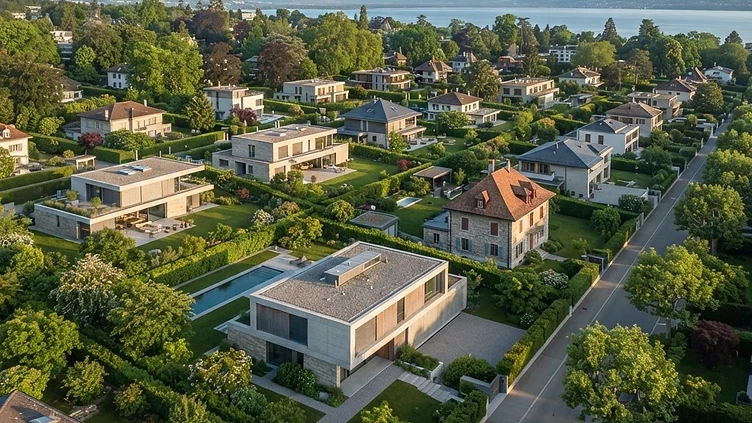

Do you own a plot in Geneva's villa zone, or are you thinking of buying land? The key question is simple: what can actually be built on it? The answer directly determines the value of the land, and therefore the price a buyer or property developer can offer.
This guide explains the Geneva LCI rules applicable to zone 5, the factors that reduce or increase potential, and how to obtain a reliable answer.
Geneva's villa zone in figures
The villa zone, or zone 5, is very extensive in Geneva. According to Le Temps, it covers around 3,000 hectares and has some 20,000 houses. With no new building zones, it has become the prime target for densification, sparking much debate between owners, municipalities and the canton.
For an owner, this is a double-edged situation: it creates strong interest from developers, but also regulatory uncertainty that needs to be managed.
The basic rule: a 0.25 floor area ratio
Article 59 of the Geneva Construction Act (LCI) sets the reference density in the villa zone: a floor area ratio (IUS) of 0.25. This ratio corresponds to the buildable gross floor area relative to the plot area.
Example: on a 1,200 m² plot, the 0.25 ratio allows in principle about 300 m² of gross floor area (1,200 × 0.25). It is this figure, not the plot area, that determines the value of building land.
This is also the basis for indicative land prices in the villa zone, which we publish municipality by municipality in our article on land prices in Geneva.
Exemptions: potential now strictly framed
The LCI provides for exemptions from the basic density (art. 59 para. 4). For years, they allowed so-called "soft" densification of many plots.
This is no longer automatic. These exemptions are now limited to sectors identified in the municipal master plans (PDCom). The canton has also stated its intention to curb soft densification in areas where it plans a more substantial transformation of the neighbourhood.
In practice, two neighbouring plots can have very different potential depending on whether or not they are in a densification sector provided for by the PDCom. This is the first point to check.
Factors that reduce potential
Even with a known floor area ratio, several factors can reduce what can actually be built or the value of the land:
- aircraft noise: in areas exposed under the aviation infrastructure sectoral plan (PSIA), building permits become more difficult or even impossible;
- protected trees: felling requires authorisation and may constrain the layout;
- easements registered in the land register: right of way, view, no-build;
- the shape and slope of the land, which complicate the layout;
- access: a back-row plot without adequate access loses part of its value;
- proximity to a major road: indicative prices apply a reduction of CHF 100 to 150/m² to plots in the first or second row of a major road.
Factors that increase potential
Conversely, some factors strengthen a plot's value:
- a densification sector provided for by the PDCom;
- a large area, or the possibility of combining several neighbouring plots;
- good public transport links, for example near the Léman Express;
- a prime location: view, lakeside, quiet.
New energy requirements
The revision of Geneva's energy regulations imposes stricter standards. For an existing villa, buyers now factor in the cost of upgrading the building envelope and replacing fossil-fuel boilers. For land intended for a new building, these requirements are part of the project from the outset and weigh on construction costs.
How to obtain a reliable answer
To find out what your plot really allows, proceed step by step:
- Consult the SITG (Geneva territorial information system) to check the zone, noise constraints and cadastral data.
- Read your municipality's master plan to see whether your sector is earmarked for densification.
- Request a land register extract to identify easements.
- Commission a feasibility study from an architect or developer, translating the rules into actual floor areas.
- If necessary, submit an information request to the department, which provides the administration's position on a preliminary project.
The OAKS GROUP view
As a property developer active in the villa zone, from Pregny-Chambésy to Vandœuvres, we find that most owners underestimate or overestimate their potential for lack of precise analysis. A serious feasibility study avoids both mistakes: selling a high-potential plot too cheaply, or holding out for an unrealistic price.
Key takeaways
- In the villa zone, the reference density is a 0.25 floor area ratio (art. 59 LCI).
- A 1,200 m² plot therefore allows in principle about 300 m² of gross floor area.
- Exemptions are now limited to sectors provided for by the PDCom.
- Aircraft noise, trees, easements, access and major roads can sharply reduce value.
- A feasibility study is the only way to know a plot's real potential.
Frequently asked questions
How do I calculate the buildable area of my land in Geneva?
In the villa zone, multiply the plot area by the reference ratio of 0.25 to obtain a first estimate of gross floor area. This result must then be adjusted for the PDCom, distances, easements and site constraints.
Can I build a second house on my plot?
It is possible if the remaining building rights, distances and access allow it. You need to check the area already built, the PDCom sector and any constraints, ideally with a feasibility study.
Does airport noise really reduce the value of land?
Yes. In areas exposed to aircraft noise, building permits can be more difficult or even impossible. Indicative prices flag a potentially significant reduction in value depending on the level of nuisance.