
02 October 2026 — Ramzi Chamat
Land-share purchase or deferred completion: risks, safeguards and the client adviser’s role
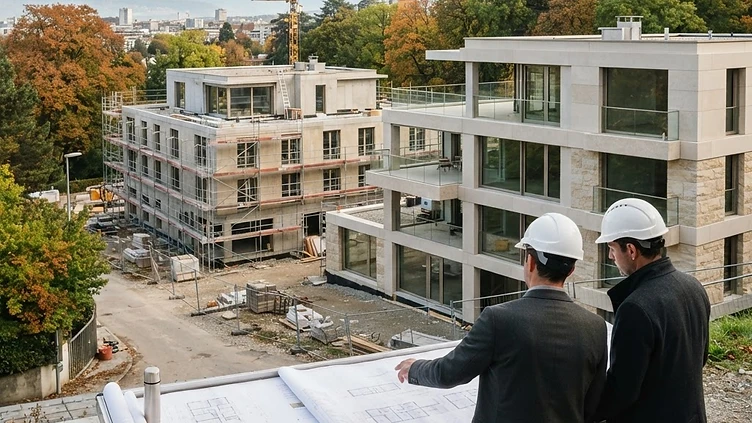

Buying a new home in Geneva is not just about comparing square footage, price, and a delivery date. One must understand when ownership is acquired, who bears the construction risk, how funds are utilized, and against whom to take action if construction issues arise.
Acquisition via land share (quote-part terrain) and forward sale (vente à terme) follow different rationales. Neither, in isolation, constitutes a guarantee of safety. The quality of contracts, the reliability of stakeholders, and the oversight of their execution are the determining factors.
At OAKS GROUP SA, we ensure the selection of the general contractors (GC) and service providers involved in our projects. For our land share developments, we integrate KERLINE SA as the project owner's assistant (AMO). This support aims to provide better decision-making oversight, identify discrepancies, and monitor construction progress, without claiming to eliminate all real estate risk.
1. Land share: what the buyer is actually purchasing
In a land share structure, the buyer purchases the land—a plot or a condominium share, typically within a co-ownership (PPE)—and simultaneously enters into a construction contract. The construction contract defines the services owed, their price, the payment schedule, deadlines, and responsibilities.
A legal distinction is essential: the transfer of real estate ownership generally occurs upon registration in the land registry, not solely by signing the notarial deed. The signing, the payment of the price, and the registration must therefore be distinguished.
In a co-ownership, a land share does not necessarily correspond to a physically delimited portion of land. The exclusive rights to the dwelling, the common areas, and any potential usage rights for a garden or terrace are derived from the constituent deeds, plans, and regulations. A garden marketed as "private" therefore warrants documentary verification.
Construction financing is generally released in stages. The buyer is more exposed to the progression of the construction site and must be able to understand what they are paying for, to whom, and based on what justification.
GC and TC: a distinction to verify in contracts
The general contractor (GC) usually coordinates the execution of works and its subcontractors. The total contractor (TC) additionally assumes, according to the contract, design services. However, these labels are not sufficient to establish the exact scope of responsibilities: one must read the included services, the exclusions, and the interfaces with the architect and engineers.
2. Forward sale: a deferred transfer, not an absence of risk
In the standard structure of a forward sale (vente à terme) from plans, the deed is signed before the completion of the home, but the transfer of ownership and the main payment occur subsequently, according to agreed-upon conditions. A deposit may be required: its amount, its recipient, and the conditions for its release must be expressly defined.
Typically, the buyer does not finance the construction site in the same way as they would with a land share. However, financing costs borne by the seller may be integrated into the price. The absence of interim interest charged directly to the buyer does not mean that construction financing is free.
Forward sale does not automatically protect against the seller's bankruptcy, the loss of an inadequately secured deposit, late delivery, or non-compliant property. Protection depends specifically on the methods of depositing funds, securities, transfer conditions, and planned remedies.
| Comparison Point | Land share | Forward sale from plans |
|---|---|---|
| Ownership | Anticipated land transfer based on land registry registration | Deferred transfer based on the deed and land registry registration |
| Commitments | Land acquisition and construction contract to be coordinated | Sales and delivery obligations to be examined in the deed and its annexes |
| Payments | Land cost followed by construction drawdowns per schedule | Potential deposit followed by balance based on agreed conditions |
| Financing | Interest and construction credit costs to be budgeted | Seller's financing which may be integrated into the price |
| Major Risks | GC default, excessive advances, cost overruns, defects, legal mortgages | Seller default, security of deposits, delays, defects, land status at transfer |
| Determining Protection | Coherent contracts, controlled payments, adapted securities, and technical monitoring | Protective deed, secured funds, clear transfer conditions, and documented acceptance |
3. Key risks to examine before signing
Default or bankruptcy of the general contractor
A general contractor (EG) can encounter financial difficulties even while the construction site appears to be progressing. Their failure can interrupt work, necessitate a takeover by other companies, and lead to additional costs. The price required to complete the building may exceed the balance still available.
Vigilance must be focused on the entity actually signing the contract, its financial capacities, its comparable references, its organization, and its workload. A well-known brand or membership in a group does not mean that other companies in the group guarantee its commitments.
Owning the land does not guarantee that one will have the necessary means to complete the housing.
Down payments that are too high or disconnected from the construction site
A schedule based solely on dates can lead to paying faster than the services are actually performed. In the event of a stoppage, the sums paid in advance will not correspond to the value actually constructed.
It is advisable to link payment requests to verifiable milestones, to monitor progress reports, and to identify the beneficiaries of payments precisely. A bank account titled "construction site account" does not, by its name alone, constitute protection against the improper use of funds. Disposal powers and control mechanisms must be established with the bank and the project's advisors.
Statutory lien of artisans: the risk of having to pay twice
This is a frequently underestimated risk. If an EG does not pay its subcontractors, they can, when legal conditions are met, request the registration of a statutory lien on the property in question. This risk exists even when the owner has already paid the EG for the services in question, as reiterated by the Federal Council on August 13, 2025.
The owner may then have to provide security or bear an additional burden to protect their property, while possessing a recourse whose effectiveness will depend, in particular, on the solvency of the EG.
Measures to consider include monitoring payments to subcontractors, targeted supporting documents, appropriate guarantees, and, if necessary, legally supervised direct payments. A simple clause requiring the EG to pay its subcontractors does not eliminate the legal rights of the latter. An improvised direct payment can also create a dispute: it must be organized with the competent stakeholders.
Overruns despite a price advertised as a fixed price
A fixed price protects the contractually defined scope; it does not make services that were not included or requested changes free of charge. The main sensitive points are earthworks, subsoil characteristics, potential pollution, connections, exterior layouts, equipment budgets, and price adjustment clauses.
A kitchen, a floor covering, or a technical installation may be proposed with an insufficient budget for the expected level of service. Each modification should therefore be the subject of a written quote specifying its price, its impact on the schedule, and its approval prior to execution.
Delays and the cost of temporary housing
A delay can compound extended rent, construction interest, furniture storage, additional moving costs, and financing extension fees. A "scheduled delivery" does not necessarily offer the same protection as a contractual deadline accompanied by clearly defined consequences.
It is necessary to examine the authorized causes for extension, the information procedure, the justification obligations, and any potential indemnities or penalties. The latter are neither automatic nor necessarily sufficient to cover all losses. Their payment also depends on the solvency of the debtor.
Construction defects and non-compliant services
Waterproofing, acoustics, insulation, ventilation, or heating adjustments can pose problems that are not visible during a sales tour. Inspections must take place at the relevant stages: certain works become difficult to verify once covered.
The acceptance procedure must allow for defects to be identified, documented, and for their resolution to be organized. It is not necessarily synonymous with the handing over of keys nor with the transfer of ownership. The contract must also make it possible to determine against whom rights should be exercised: the seller, the EG, the ET (General Contractor/Architect), or other stakeholders, depending on the structure.
Land, permits, and organization of the condominium (PPE)
Before committing, one must verify the permits and their enforceability, any uncleared conditions, easements, access points, connections, and available technical studies. An authorized construction site is not necessarily free of all realization constraints.
For co-ownership (PPE), common areas require specific attention: handover, guarantees, charges, maintenance, and decision-making procedures. The contract must also specify the consequences of a default in payment by another purchaser and the possible existence of collective obligations. One must neither presume solidarity between buyers nor assume that it is excluded.
4. The real cost: comparing more than just acquisition fees
The land share approach may offer economic benefits, but savings on acquisition fees should never be presented as automatic or as the sole criterion for selection. Rules depend on the canton and the structure. In Geneva, one must examine the treatment of the construction contract, not just the land itself.
The notary must establish an estimate adapted to the file: acquisition taxes and fees, registration in the land register, constitution of mortgage guarantees, and any applicable reliefs. It is then necessary to add construction interest, bank commissions, services outside the contract, modifications, and a reserve for contingencies.
Purely illustrative example: credit utilized up to an average of CHF 450'000, at a hypothetical rate of 2.5% per annum for 18 months, represents approximately CHF 16'875 in simple interest, excluding commissions and other fees. Three additional months at the same average outstanding amount and the same rate add approximately CHF 2'813. This is neither an advertised market rate nor a financing offer.
This calculation shows why the initial saving must be compared with the total cost and a delay scenario. The future rate for consolidating the credit into a mortgage and the conditions for maintaining the bank's agreement also deserve to be clarified.
5. OAKS GROUP SA: selecting the right partners
We believe that the quality of a development begins with the choice of those who will carry it out. At OAKS GROUP SA, we ensure the selection of general contractors and service providers adapted to the requirements of our operations. Price cannot be the only criterion: the ability to meet commitments and handle difficulties counts just as much.
A rigorous selection process must examine several complementary dimensions:
- Relevant experience: references on comparable operations, quality of achievements, and ability to intervene in the local context.
- The solidity of the contractual partner: financial situation, insurance, guarantees offered, and understanding of their limits.
- Execution resources: available teams, organization, workload, management, and network of subcontractors.
- Clarity of the offer: included services, exclusions, budgets, schedule, and handling of modifications.
- Transparency during the construction site: ability to document progress, decisions, payments, and correction of deviations.
This requirement for selection must be extended by monitoring during construction. A company selected at the start remains exposed to hazards; therefore, vigilance does not end with the signing of the contract.
Our commitment to selection and support is not a general guarantee against bankruptcy, delays, or defects, and does not replace the security expressly provided for each operation.
6. Why integrate KERLINE SA as an Owner's Representative (AMO)?
In our land share developments, we integrate KERLINE SA as an assistant to the owner (AMO) in order to provide technical and contractual support for this structure. The project owner is the person for whom the work is carried out; their identity and the organization of their representation must be clearly established in the project documents.
The AMO helps to understand, verify, and decide. Its value lies in reducing the information asymmetry between a non-specialist purchaser and construction professionals by transforming general commitments into concrete checkpoints.
KERLINE SA notably provides tasks such as analyzing contractual documents, technical verification during site visits, assistance with handover, and follow-up of guarantees. The scope actually entrusted to KERLINE SA, its principal, its fees, its powers, and its reporting procedures are defined in the specific mandate for the operation. Its integration therefore does not mean that every conceivable service is automatically included or free of charge.
Before signing: understanding the commitments
Depending on its mandate, the AMO analyzes the consistency between plans, the technical description, the construction contract, and the schedule. It identifies gray areas, missing services, and poorly defined interfaces. It helps the project owner formulate questions to submit to the General Contractor (EG), the developer, the bank, and the notary.
It can thus draw attention to an insufficient finishing budget, an overly broad modification clause, or a discrepancy between commercial illustrations and contractual documents. Its technical and contractual analysis does not replace specialized legal or tax consultation.
During the construction phase: monitoring quality, costs, and deadlines
The Project Management Assistant (AMO) can carry out the visits provided for in the mandate, identify deviations from the agreed services, analyze progress, and alert on the consequences of a decision. Its involvement may include examining work progress reports and modifications, within the limits of the entrusted mission.
The added value lies in traceability: minutes, photographic evidence, lists of decisions to be taken, monitoring of deviations, and recommendations. The goal is to identify a problem early enough to allow for action, rather than discovering the consequences at the time of delivery.
At handover: documenting defects
The AMO accompanies the project owner in the inspection of the property and, if the mandate provides for it, the common areas. It contributes to establishing a precise record of defects, their location, the expected interventions, and the correction deadlines. It also helps verify the handover of manuals, as-built plans, certifications, and relevant warranty documents.
After delivery: following up on corrections and warranties
The support can continue with the monitoring of the rectification of defects, the documentation of defects discovered subsequently, and assistance in notifying claims to the appropriate parties. A distinction must be made between the technical finding of a defect, its legally valid notification, and the measures necessary to preserve deadlines.
What the AMO does not replace
The AMO is neither the General Contractor (EG), nor insurance, nor a bank completion guarantee. It does not automatically replace the architect or the construction management, whose responsibilities remain those defined by their contracts. Construction management is a distinct mission, even when a company has the skills to offer both services.
The AMO does not sign modifications, does not release funds, and does not commit the project owner without corresponding authority. Its assistance also does not exempt any party from their own obligations. The mandate must specify the rules for representation, confidentiality, and the management of potential conflicts of interest.
7. Warranties: demand a document, not just a promise
The words "guaranteed," "secure," or "turnkey" are not enough. For every advertised security, it is necessary to identify the issuer, the beneficiary, the amount, the risks covered, the call conditions, and the expiration date.
A down payment refund guarantee, a performance bond, and a defect warranty do not protect against the same events. Civil liability insurance does not automatically cover the insolvency of the company or the total cost of completion.
These protections must be negotiated and verified for the specific operation concerned. Their availability and scope cannot be inferred solely from the fact that a General Contractor (EG) or an AMO is participating in the project.
8. Construction defects: taking into account the rules that came into force in 2026
The Federal Council has set January 1, 2026, as the effective date for new rules strengthening the protection of project owners and buyers. For contracts covered by the reform, the notice period for apparent and hidden defects is extended to 60 days, from the time of delivery or discovery of the defect, as applicable. This period cannot be shortened contractually within the scope of these provisions.
The reform also protects the right to repair in the targeted situations. The official communiqué mentions construction contracts as well as sales of buildings involving a construction to be erected or erected within the two years preceding the sale.
However, the regime applicable to the contract must be verified, particularly its date of conclusion and the transitional rules. The notice period is not the limitation period for rights. It remains prudent to document and notify any defect promptly, without waiting for the final deadline.
Finally, the SIA 118 standard does not apply simply because a building is located in Switzerland: its integration into the contract and its coordination with mandatory provisions must be examined.
9. Documents to request before committing
-
The draft notarial deed, relevant land registry information, and easements.
-
Authorizations, approved plans, and any conditions that may still need to be fulfilled.
-
The complete GC (General Contractor) or CP (Construction Promoter) contract, its description, its appendices, and the order of precedence of documents.
-
The overall budget distinguishing between land, construction, costs, financing, and excluded services.
-
The payment schedule, required supporting documents, and the persons authorized to validate them.
-
The guarantees and insurance certificates actually offered, along with their terms and conditions.
-
The contractual timeline, cases for extension, and the consequences of delay.
-
The AMO (Project Management Assistance) mandate: identity of the principal, services, powers, fees, and reports.
-
The PPE (condominium) documents and the organization of the handover of common areas, if applicable.
-
The procedure for modifications, acceptance, notification of defects, and warranty follow-up.
A missing document does not automatically imply a problematic project. However, answers must be obtained before the purchaser makes commitments they do not understand or can no longer renegotiate.
Conclusion: a well-supported structure rather than assumed security
The land share (quote-part terrain) approach can be a relevant solution when financing, responsibilities, payments, and oversight are properly organized. A forward sale (vente à terme) may suit some purchasers better, but it deserves the same vigilance regarding committed funds, delivery, and guarantees.
OAKS GROUP SA's position is clear: select quality GCs and service providers, and integrate KERLINE SA as an AMO in our land share developments to strengthen support for the project owner. This organization aims to better prevent, detect, and address difficulties; it should never be presented as the total elimination of risks.
Are you considering an off-plan purchase? Contact OAKS GROUP SA to examine the proposed structure, the parties involved, and the support provided for the operation.
Sources and references
- Federal Council, April 30, 2025: construction defects, new rules applicable from January 1, 2026.
- Federal Council, August 13, 2025: legal mortgage for artisans and contractors and risks for owners.
- KERLINE SA: presentation of the project management assistance mission.
- Naef Immobilier: practical presentation of different off-plan purchases, to be read subject to the rules and conditions specific to each file.
- Our 2023 article on land share and forward sales, which this new analysis deepens and nuances regarding points related to risks, transfer of ownership, and overall cost.
Article published on October 2, 2026. General information regarding the Swiss context, with a focus on Geneva; it does not replace the examination of deeds by a notary, lawyer, or tax advisor, nor a banking offer. The services and guarantees mentioned are only acquired within the limits of the contracts and mandates actually concluded.