26 November 2026 — Ramzi Chamat
Employers demand simpler building permit procedures
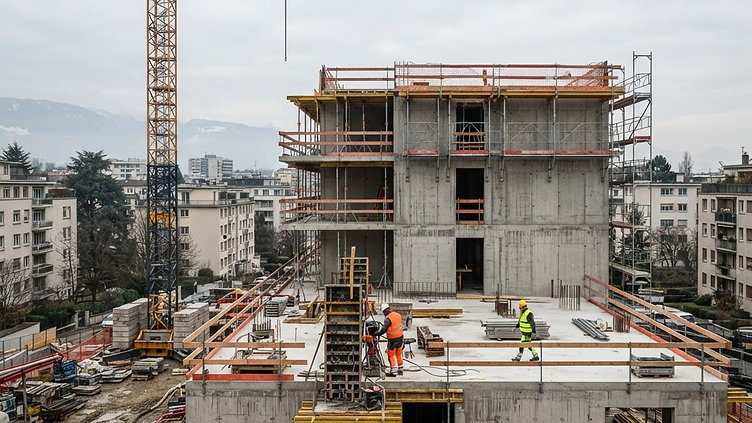

Switzerland builds fewer homes than it consumes every year. The Swiss Contractors' Association and Economiesuisse put the shortfall at more than 10,000 homes a year, for more than 20,000 people. Their answer fits in one word: simplify. Behind the slogan lie deadlines, one-stop offices and appeal procedures — and, for anyone carrying a project, a way of working that has to change.
What the business federations are asking
In a statement published on Thursday, the two organisations call for national minimum standards for building and permit procedures. The stated aim is to unblock housing construction, at a time when high rents weigh on both households and companies.
The diagnosis comes in three lines:
- authorisations that are slow to be reviewed;
- rules that pile up on a single project;
- appeals open at two levels, cantonal and municipal.
One figure sums it up: depending on the canton, up to 40 specialised departments review a single building permit application. And processing times have not merely held steady, they have lengthened. In Geneva a permit now takes 497 days on average; in 2010 the same procedure took 212.
What 497 days actually cost
A permit deadline is not an administrative detail. It is capital tied up, studies that must be refreshed, contractors to be re-mobilised, a sale price or a rent fixed two years before delivery. The timeline of a property development runs from plot to keys, and every month of review is paid twice: in interest and in lost opportunity.
Stage | What is at stake | Effect of a longer procedure |
|---|---|---|
Studies and preliminary design | feasibility, volume, parking | studies redone when the rules move |
Submission and review | examination by each department | every extra department adds another round |
Public enquiry and appeals | objections, appeal deadlines | a suspensive appeal freezes the whole schedule |
Construction | tenders, financing, costs | interest rates and prices have moved |
For an owner or an investor, the conclusion is simple: procedure risk has become a cost line of its own. It can be quantified, provisioned, and increasingly decides whether a project is viable at all.
What the employers want
The associations propose a national framework without taking spatial planning away from the cantons: each canton would keep its own solutions, provided it meets a shared baseline. Three concrete demands:
- binding deadlines, enforceable against the reviewing departments;
- a one-stop office per canton, the applicant's single contact;
- tighter appeal routes, so a project does not stall for years.
The reforms Parliament has voted are already on paper. What is missing is their application: that is where the next turn lies.
In Geneva the same logic is carried by Motion M 3216, which targets the complexity of planning and building procedures. The issue is no longer only federal: it has become a leading cantonal topic.
The limit of the argument
Simplifying procedures does not build homes on its own. Three other locks matter just as much: available land and its price, the production capacity of the construction sector, and the densification actually permitted by municipal plans, on which most of the potential in Geneva and Vaud depends. A vacancy rate below 1% is not explained by slow permits alone.
A second caveat: minimum standards can also lower the quality of review — energy, mobility, heritage. The right question is not "fewer rules" but "readable rules, applied once, within a known deadline".
What a project owner can do now
- Pre-consult before filing. A session with the relevant departments costs a few weeks and often saves a six-month round trip.
- Deliver a complete file first time. It remains the most effective and least expensive lever.
- Anticipate appeals. A project never explained to neighbours is hard to defend, and a challenged permit is worth nothing until it is legally in force.
- Price the time. Treat the 497 days as a financial input, not a residual uncertainty.
- Get support. An owner alone in front of forty departments has no negotiating room; that is precisely the role of client-side project management.
What we take from it
The employers' demand names a measurable problem, with verifiable figures and a concrete proposal. It does not relieve project owners of organising themselves: as long as deadlines are not binding, the one variable an owner truly controls is the preparation of the file — and the choice of who carries it.
Source: AWP/ATS release of 26 November 2026; analysis by OAKS GROUP SA.