17 October 2026 — Ramzi Chamat
Trees and urban density: rethinking Swiss property development
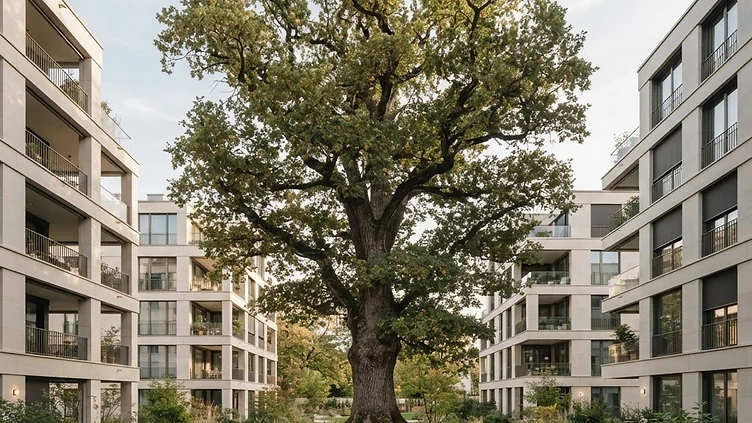

Tree protection and urban density in Switzerland need to be considered together from the first assessment of a site. Creating more homes does not remove the need to examine existing trees, while protecting trees does not mean ruling out all development. For landowners and developers, the practical question is what can actually be approved, and on what terms.
In his article published on immobilier.ch on 12 October 2026, Serge Guertchakoff examines the growing importance of trees in planning decisions. His reporting is the main source for this analysis, supplemented by official information from Geneva, the canton of Vaud and the Federal Office for Housing. It suggests reframing the debate: rather than choosing between trees and housing in the abstract, projects need to address both needs together.
Tree protection and urban density: beyond a false choice
A tree is not simply a decorative feature to be added once a project is complete. Retaining it involves the quality of outdoor space, adaptation to heat and how people experience a neighbourhood. Geneva’s official guidance notes that felling trees can intensify urban heat islands and reduce a site’s value.
In the immobilier.ch report, Geneva State Councillor Nicolas Walder advocates case-by-case assessment rather than a general hierarchy between housing construction and canopy conservation. He also highlights how parking and underground utilities affect the space available for vegetation.
This approach is consistent with the Federal Office for Housing’s statement of 4 September 2025 on balancing interests in high-quality inward development. Identifying interests, assessing them and comparing alternatives helps substantiate planning decisions. Increasing density is a planning objective, not an exemption from assessing a particular site.
Geneva: integrate tree permission into the building project
Geneva’s official guidance on tree felling associated with construction states that the application must be submitted at the same time as the building permit application. This procedure covers, among other cases, new buildings, extensions and alterations that require a tree to be felled.
The supporting documents include a plan locating the trees to be removed, a valuation under USSP standards, a landscape plan identifying proposed planting, and photographs of vegetation to be removed or retained. A reduction in the tree stock is, in principle, subject to a requirement for compensatory measures.
For developers, the implication is practical: tree assessment and landscape planning should inform the architecture rather than attempt to correct a design that is already fixed. A tree’s presence does not, by itself, make a plot unbuildable. Equally, development potential does not amount to permission to fell trees.
Forthcoming regulation must be distinguished from rules already in force. Geneva’s official page on tree-policy instruments announces that the regulation on the protection and development of the tree heritage, the RPDPA, will enter into force in 2027, replacing the RCVA. That announced timetable does not make the future framework applicable in October 2026.
Vaud: protection, permission and compensation are separate stages
In the canton of Vaud, the Natural and Landscape Heritage Protection Act, the LPrPNP, entered into force on 1 January 2023. Its implementing regulation took effect on 1 July 2024, according to the canton’s statement on the reform.
The framework is not limited to particularly impressive individual trees. Cantonal information describes a heritage that includes trees, hedges and small wooded groups, and sets out responsibilities for municipalities, the canton and owners. Assessing a plot therefore also means checking municipal rules and any relevant inventories.
For construction and development projects, the canton provides for a compensatory levy where compensation through planting is impossible. The levy is not a way to buy permission to fell a tree. The legal grounds for removing a protected feature, the conditions attached to approval and the compensation for an authorised intervention are distinct issues.
Amounts and arrangements must be assessed for the specific case. A local example cannot be turned into a standard tariff for every tree in Switzerland.
Property feasibility also depends on what happens underground
The immobilier.ch investigation highlights an often underestimated issue: retaining a tree involves more than avoiding its trunk on a drawing. The arrangement of basements, access routes and utility networks needs to be examined with tree specialists.
Our property-development assessment is that theoretical buildable floor area alone does not determine a site’s practical development value. Design changes, potential assessment and compensation costs, and procedural uncertainties also matter. These factors can alter a project’s economics without necessarily reducing the land’s value.
Conversely, a retained tree that is successfully integrated can contribute to the quality of homes and shared outdoor spaces. That does not justify promising a specific price premium or a faster approval. Such effects should remain assumptions to examine rather than established benefits in a financial appraisal.
Five checks before committing to an acquisition or a design
For OAKS GROUP, a property development company investing on its own account, the significance of this shift is the need to bring a site’s constraints and strengths into land decisions earlier. A useful assessment framework is to:
- Document existing conditions: tree locations, condition and protection status, with qualified professional input.
- Check the applicable framework: canton, municipality, inventories and procedures relevant to the actual plot.
- Compare layout options: buildings, parking, access, utilities and open ground, without assuming any option will automatically be approved.
- Separate cost categories: assessments, design changes, protection during construction and any compensatory measures.
- Keep room for decisions: do not treat an assumed right to fell trees as an established entitlement when valuing land.
These are preparation recommendations, not a uniform checklist of legal obligations. The aim is to identify trade-offs early enough to avoid discovering a fundamental constraint after the project’s economics have already been fixed.
Key takeaways
Tree protection primarily changes how developments should be prepared. In both Geneva and Vaud, permission, conservation and compensation need to be addressed together, without confusing their roles or transferring one jurisdiction’s rules to another.
OAKS GROUP’s position is to pursue credible densification: additional homes where the framework allows, alongside a coherent approach to soil, landscape and everyday use. Trees should therefore be treated as a design and feasibility consideration, not merely a problem to solve at the end.
Frequently Asked Questions
Can a tree on private land be felled to build in Geneva?
Owning the land is not sufficient permission to fell a tree. Where felling is associated with a building project, the application must accompany the building permit application; the authority assesses the case, and compensatory measures are generally required.
Does paying a compensatory levy allow unrestricted tree removal in Vaud?
No. For a construction or development project, a levy may apply where compensation through planting is impossible, but it does not replace the permission assessment. The relevant rules and conditions must be checked for the individual plot.
Is Geneva’s new tree-protection regulation already applicable?
The official page consulted announces that the RPDPA will enter into force in 2027, replacing the RCVA. That announcement should not be treated as a rule already applicable in October 2026; the framework in force when the application is made should be confirmed with the competent authority.
Sources
Sources consulted on 17 October 2026. Practical requirements should be confirmed with the competent authority for each application.
- Main source: Serge Guertchakoff, immobilier.ch, “La sacralisation de l’arbre, nouveau défi pour la densification urbaine en Suisse”, 12 October 2026
- Canton of Geneva: tree felling and pruning guidance, updated 29 October 2025
- Canton of Geneva: tree felling associated with construction, updated 29 October 2025
- Canton of Geneva: tree-policy instruments and announced RPDPA commencement in 2027
- Canton of Vaud: tree heritage, responsibilities and protection framework
- Canton of Vaud: new biodiversity protection regulation, commencement dates of 1 January 2023 and 1 July 2024
- Federal Office for Housing: guidance on balancing interests in high-quality inward development, statement of 4 September 2025