14 November 2026 — Ramzi Chamat
Selling Your Land to a Developer in Geneva with Your Neighbours
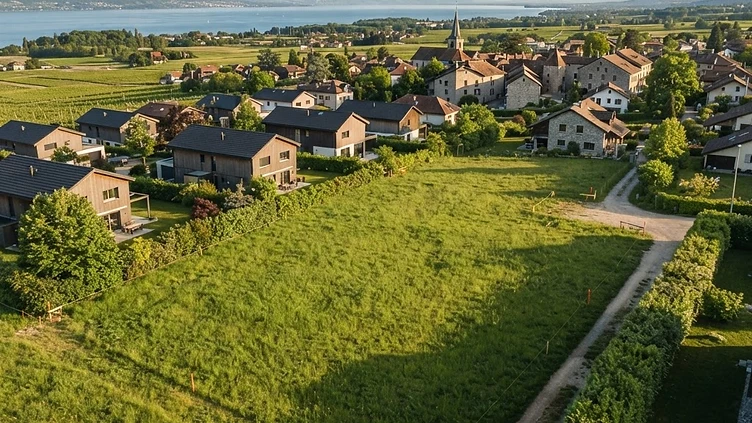

Do you own a villa in Geneva, and has a property developer shown interest in your neighbourhood? Before answering alone, talk to your neighbours. Plot assembly is often what turns a hard-to-develop piece of land into a real property development project in Geneva. For a developer, two, three or four adjoining plots allow a freer layout, shared access and a more coherent design. For owners, it is frequently the condition for a stronger and faster offer.
This guide explains how a developer calculates the price of a group of plots, how that price is split between sellers, the legal steps involved and the mistakes to avoid.
Why a property developer values a group of plots more highly
In zone 5 (villa zone), the reference density is a floor area ratio (IUS) of 0.25 under article 59 of the Geneva Construction Act (LCI). In practice, a 1,000 m² plot allows roughly 250 m² of gross floor area.
On a small, isolated plot, this potential often remains theoretical. Boundary distances, road access, protected trees, slope or the shape of the land reduce what can actually be built. A narrow plot can lose a significant part of its building rights.
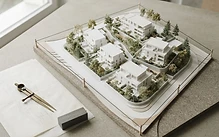
By combining several plots, you generally get:
- a more rational footprint, making full use of each plot's building rights;
- a single access road and one underground car park, sharply reducing the cost per home;
- a more coherent architectural project, better accepted by the municipality, the architecture commission and neighbours;
- fewer overlooking constraints between buildings, so homes that are easier to sell;
- a single construction site, with economies of scale on earthworks and utility connections.
The gain does not come from an automatic legal "bonus", but from better use of the existing potential. This is precisely what the developer can afford to pay extra for.
Density exemptions: a lever to verify, not to assume
The LCI provides for higher density in the villa zone (art. 59 para. 4). These exemptions are now limited to sectors identified in the municipal master plans (PDCom). Before any negotiation, check which sector your plots are in.
An assembly in a sector where the municipality accepts densification will be far more attractive. Conversely, in a protected sector or one exposed to aircraft noise (PSIA), value may be sharply reduced. Never sign on the basis of an assumed density: ask for a written analysis.
How the price of each plot is calculated
A property developer in Geneva reasons in terms of residual value. Starting from the realistic sale price of the future homes, they deduct:
- construction and demolition costs;
- fees (architect, engineers, surveyor, notary);
- taxes and charges;
- financing costs for the whole duration of the project;
- their risk margin.
What remains is what they can pay for the land. This is why two developers can make very different offers: they do not share the same view of the exit price, the project or the risk.
In a plot assembly, this overall amount must then be split between the sellers. Three allocation keys are common:
- per m² of land, the simplest and most transparent for everyone;
- in proportion to the building rights actually contributed by each plot;
- a mixed key, taking specific situations into account: access plot, easement, building to be demolished, protected tree.
The key point: the allocation must be agreed before signing, in writing, and accepted by all. It is what prevents tensions between neighbours during months of procedure.
To position your land, see our Geneva land price guide by municipality. It gives indicative ranges in the villa zone, but only a project analysis provides a reliable land valuation in Geneva.
The steps of a successful plot assembly
- An initial discussion between neighbours to check each party's interest and preferred timeline (relocation, retirement, inheritance).
- An analysis of the combined potential: zoning, PDCom, easements in the land register, noise, trees, access.
- A project sketch by the developer, used to calculate the residual value.
- A written global offer, including the allocation key, timeline and conditions.
- Promises of sale signed before a notary, usually conditional on obtaining a building permit that is final, i.e. with no pending appeal.
- Filing the permit application, its review and the appeal period.
- The final sale once the conditions are met, with payment of the price.
Between the first discussion and the final sale, allow for the time needed for the building permit and any appeals. A realistic timeline is part of the offer.
Tax: what each seller should anticipate
Each owner is taxed individually on their own sale. In Geneva, the capital gain is subject to the real estate gains tax (IBGI), whose rate depends in particular on the holding period. Acquisition costs and documented value-adding works can reduce the taxable gain.
Before signing, each seller should therefore have their tax calculated by their adviser. We have detailed the mechanism in our guide to real estate gains tax in Geneva.
Pitfalls to avoid
- The neighbour who blocks: if a key plot withdraws, the whole project may collapse. Agree from the outset what happens in that case.
- Open-ended conditions: a promise of sale without a deadline can tie up your property for years. Insist on a maximum term and controlled extensions.
- Forgotten easements: a right of way or a no-build easement can sharply reduce value. Have the land register checked from the start.
- Comparing offers that are not comparable: a high price with fragile conditions is often worth less than a lower price with a firm timeline.
- Negotiating separately: separate discussions create mistrust and weaken the whole group.
How to compare two developer offers
Criterion | Question to ask |
|---|---|
Price | Overall price and share for each plot? |
Conditions | Which conditions precedent exactly? |
Timeline | Deadline for the promise and the sale? |
Guarantees | Deposit paid on signing? |
Track record | Comparable projects completed in Geneva? |
The OAKS GROUP view
In our villa-zone development projects, assemblies of two to four plots are common. What makes the difference is not only the price but transparency: one offer, a clear allocation key and a realistic timeline for each owner. A well-prepared assembly protects the sellers as much as the project.
Key takeaways
- Combining plots makes it possible to use the full 0.25 floor area ratio in the villa zone, and sometimes more in sectors provided for by the PDCom.
- The overall price is calculated as a residual value, then split between sellers using a written key.
- Promises of sale are usually conditional on a final building permit, with a deadline to negotiate.
- Each seller remains subject to IBGI on their own capital gain.
- An easement or a neighbour pulling out can undo everything: anticipate it in the contracts.
Frequently asked questions
Do all neighbours have to sell at the same time?
No, but signatures must be coordinated. Promises of sale are usually signed on close dates and linked to each other, so that no owner remains committed alone if the project does not go ahead.
Is the price per m² the same for everyone?
Not necessarily. A plot that provides access or more building rights may justify a larger share. What matters is that the allocation key is known and accepted by all before signing.
What happens if the building permit is refused?
If the promise of sale is conditional on a final permit, it lapses and each owner regains full control of their property. This is why a clear deadline in the contract is so important.